Connect the display to specific behaviors
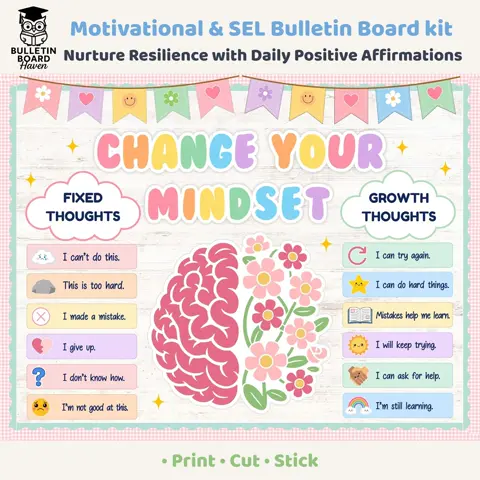
Encouraging words have more value when students understand what they can do next. Pair ideas such as persistence and courage with concrete actions: try another strategy, ask a focused question, study an example, use feedback, or revise one part.
Choose a small number of phrases you will actually use during instruction. Repeated language becomes part of classroom culture; a wall full of unrelated slogans is easier to ignore.
Show that learning includes revision
Create space for examples that changed over time. A first attempt, feedback note, revised attempt, and student reflection can show the learning process more honestly than displaying only perfect final work.
Protect student dignity by asking permission, removing grades when appropriate, and focusing captions on strategies rather than comparing learners.
Invite student thinking
Add a rotating prompt such as What strategy helped you today? or What did you change after feedback? Student responses make the display connected to current learning and provide language classmates can borrow.
Use removable cards or a small writing area so the board can change without a complete redesign. Fresh examples give students a reason to look again.
Use the display during instruction
Refer to the board when modeling a difficult task, conferencing with a student, or reflecting after an assessment. A display becomes meaningful when it is part of conversation rather than something students only see in the background.
Review the language periodically and remove phrases that feel vague or overused. Replace them with strategies connected to the challenges students are currently facing.